
Slugs and Snails
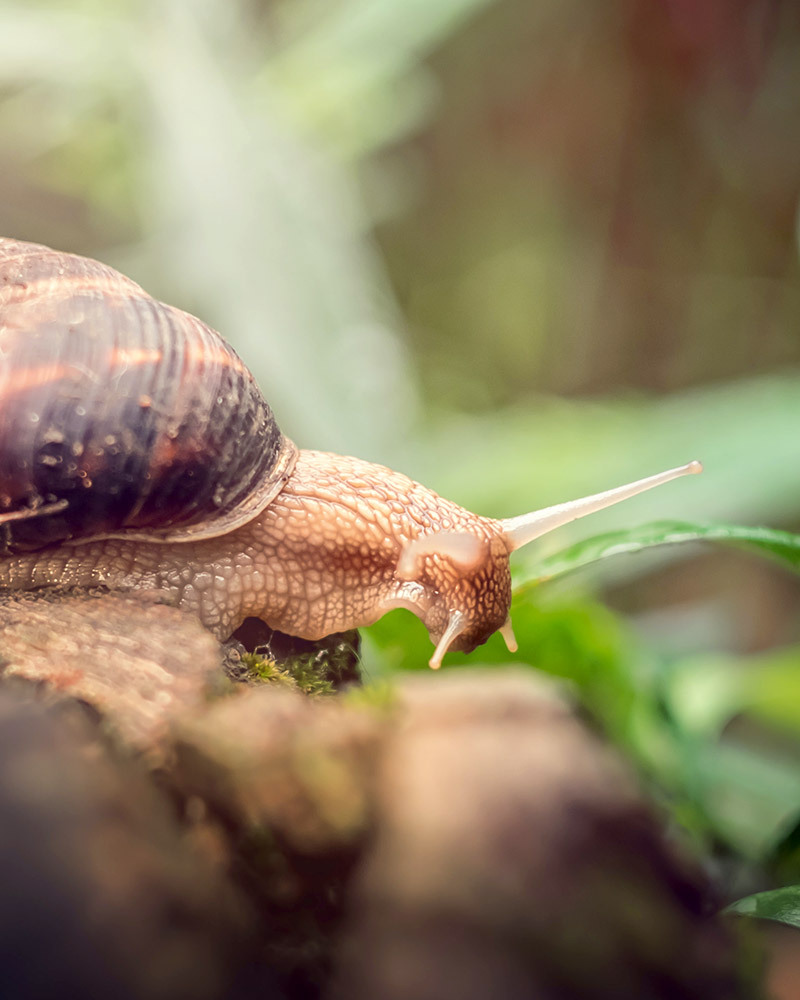
Slugs and snails are the bane of many a gardener's existence. The disappointment of yet more disappearing seedlings after so much effort to bring them into life and all that is left is the tell-tale slimy trail. It is so demoralising.
These copper garden tools are not a magic bullet, the definitive deterrent. But we have found that since we started using them, the amount of slug and snail damage has dramatically reduced in our garden. Many of our customers have reported that using the tools has the effect of a slug barrier - even protecting hosta plants.
On this page we include some of the feedback from users of the tools, and a possible explanation of why using them should make a difference - even when we do not leave the tools in the soil.
Feedback
We started using a copper trowel in the garden some two years ago and we have had wonderful hostas and other plants ever since. Up to that time, slugs and snails had been a major problem in the garden, with hosta leaves looking like fine lace. We still find the odd nibble on a plant but we can live with that.
... Whatever the scientific validity of the theory, in practice the use of copper tools seems to work!
trialled in tunnels - noticed a large reduction in slugs & snails - now in 4th year.
I have been using PKS Copper gardening tools for 6 years (I think it is that) and I really love these tools - excellent for delicate weeding with really comfortable handles and sharp 'digging deep' bespoke designs. I remember reading with my daughter about the Egyptians when she was young and we discovered that they also used copper for their garden tools. I highly recommend these tools and they do seem to keep the slugs and snails away too.
I needed to prepare a bed for my French Beans which was weedy and had two plastic bags of leaves on it, gathered last Autumn. There were a lot of large slugs under them which I left where they were. I weeded in my usual way using an iron fork where necessary for deep rooted weeds. I then cultivated using a copper cultivator and a copper rake. This was all done on very dry soil.
Next day I planted some Swiss Chard. The following day there was no slug damage so I planted my French Beans. This was all about 10 days ago and there is still no slug damage to be seen!
Snails and slugs are often a problem in the garden, especially if (like me) you love hostas. One thing that slugs appear to hate is copper, so I have started using a copper 'Castor' trowel not only to plant the hostas, but also to weed the bed they are in. They are available from a company called Implementations and although this blog is not a scientific study, I use them as part of my 'weapons arsenal' against slugs and snails.
... so what's going on? We think it may be to do with electricity and magnetism.
We live in the Earth's magnetic field, which is sustained by the movement of the relatively high iron content in the Earth's mantle. Any piece of iron can have its own magnetic field. The metal copper, on the other hand, is non-magnetic and highly electrically conductive.
Electricity, magnetism and movement form a team together. If you have two of them, the third will appear. A wind-up torch or radio has a little magnet in it. Your action of winding it up generates the electricity for it to work.
We, and all other mammals, have iron in our blood. That is why our blood is red. It enables each of us to have our own independent magnetic field, anchored on our blood. Slugs and snails do not have iron in their blood. Their blood contains haemocyanin, based on copper. This means that they do not have an independent magnetic field. As copper is conductive, they are highly sensitive to the Earth's field. As they move along the ground, they are subject to the lines of magnetic force generated by the rotating core of the Earth.
Now, imagine that a diligent gardener has carefully transplanted their lettuce seedlings, using an iron tool. As the tool turned the soil, it left its magnetic signature. When night falls, the slugs and snails start on their slimy way, following the lines of force that they detect on the soil surface. When they reach this disturbance around the transplanted lettuces, they are forced to stop. They do not know where to go - the signal is not clear. They have to wait, and while they wait, they get hungry. And there go the lettuces. Using a copper tool leaves no magnetic disturbance, so there is nothing to attract the slimy molluscs.
This is one strand of the story. More information can be found in our booklet, the Story of Copper Garden Tools. If you have any thoughts or feedback, please phone, write or email us.
Curio Ponder
